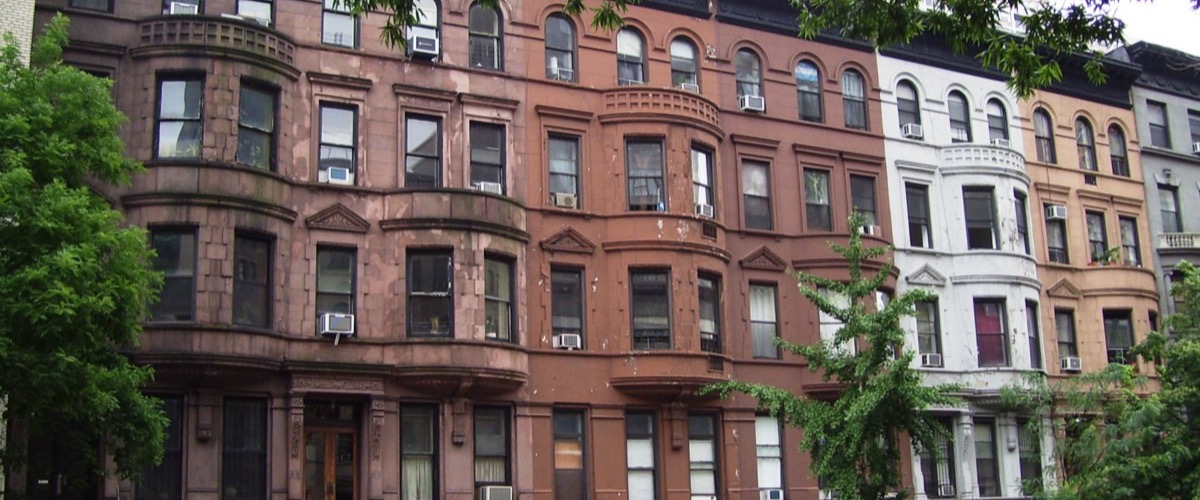
Downsizing on the Upper West Side
The Upper West Side runs between Central Park and the Hudson River, and its apartment buildings, historic districts and two large parks give downsizers a lot to compare. This page covers the housing types, transit, hospitals, storm questions and taxes that matter when you move from a larger home into an elevator building or a townhouse floor.
- Local government
- City of New York (New York County)
- Smaller-home types
- Co-ops, condos, townhouse floor-throughs
- Nearby hospitals
- Mount Sinai Morningside and Mount Sinai West
- Evacuation zone
- Check by address
The Upper West Side at a glance
Central Park covers 843 acres from 59th to 110th Street and Fifth Avenue to Eighth Avenue, and Riverside Park stretches four miles along the Hudson from 72nd to 158th Street. The neighborhood sits between the two, which is why park access, and the walk to it, is a fair thing to test block by block.
The city's Landmarks Preservation Commission has designated several historic districts here: the Upper West Side/Central Park West Historic District, the Riverside-West End Historic District with two extensions, the Riverside Drive-West 80th-81st Street Historic District and the Riverside-West 105th Street Historic District. If a building you like is inside one, exterior changes go through that agency.
Sources: NYC Landmarks Preservation Commission, Manhattan historic districts; Central Park Conservancy; NYC Parks, Riverside Park.
Co-ops, condos and townhouses on the Upper West Side
Downsizers here are usually choosing between an apartment in an elevator building and a floor of a townhouse. The trade-offs differ.
- Co-op apartments. You buy shares in a corporation and receive a proprietary lease. The board's application process, the building's financial rules, any flip tax and the sublet policy all come from the building's own documents, not from state law.
- Condominiums. You own a deeded unit plus a share of the common elements. Common charges follow the declaration and bylaws, and whether the board has a right of first refusal on a sale depends on what those documents say.
- Townhouse floor-throughs. A full floor of a converted townhouse can give you a single level with no shared lobby, but many have stairs and no elevator. Check the entry steps, the route to the laundry and the state of the building's roof and systems.
Condos and co-ops are outside the state's Property Condition Disclosure Act, so the offering plan, financial statements and board minutes carry more weight than a seller's disclosure form. New York City also adopted a 2026 law setting time limits for co-op boards to act on applications; one law firm summary describes it, and your attorney can confirm whether it covers a given building. Compare formats in our co-op, condo, townhouse or house guide.
Sources: NY Real Property Law sec. 461; NY Attorney General, cooperatives; NY Attorney General, condominiums.
Getting around the Upper West Side
The MTA's 1 line page shows local stops on Broadway at 66 St-Lincoln Center, 72 St, 79 St, 86 St and 96 St, with the 2 and 3 also stopping at 72 St and 96 St. The C, and the B on weekdays until 11 p.m., serve Central Park West stations including 72 St, 81 St-Museum of Natural History, 86 St and 96 St. Elevator access varies by station, so check the MTA's accessible stations list for the ones you would use. For a specific trip, use the MTA trip planner.
Sources: MTA, 1 line map; MTA, C line map.
Hospitals and health care near the Upper West Side
Mount Sinai Morningside, at 1111 Amsterdam Avenue, describes itself as serving West Harlem and Morningside Heights and operates a Level 2 trauma center. Mount Sinai West, at 1000 Tenth Avenue, has a 24/7 emergency department serving Midtown and the West Side. Check which hospitals and specialists your insurer and doctors use before you let a map decide for you.
Sources: Mount Sinai Morningside; Mount Sinai West.
Parks, libraries and everyday life on the Upper West Side
- Riverside Park. Its waterfront promenade carries a stretch of the Manhattan Waterfront Greenway, and a 110-slip public marina sits at 79th Street.
- Greenmarkets. The 79th Street Greenmarket runs behind the American Museum of Natural History every Sunday year-round, and the Tucker Square Greenmarket at West 66th Street and Columbus Avenue opens Thursdays and Saturdays.
- Libraries. New York Public Library branches include Riverside at 127 Amsterdam Avenue, Bloomingdale and St. Agnes on Amsterdam Avenue.
- Older adult programs. Goddard Riverside, based at 593 Columbus Avenue, runs older adult centers, and NYC Aging lets you find a center near you. Membership at NYC Aging centers is free for people 60 and older.
Sources: GrowNYC Greenmarkets; NYPL locations; Goddard Riverside; NYC Aging older adult centers.
Storms, flooding and insurance on the Upper West Side
Flood and evacuation risk differ by block, and the two maps measure different things. New York City's evacuation zones rank storm surge risk, while FEMA flood maps drive insurance requirements. Look up any address you are considering in the city's hurricane evacuation zone finder and on the FEMA Flood Map Service Center. Standard condo and co-op policies exclude flood, and a condo or co-op owner's own policy generally covers the interior and contents while the building's policy covers the structure. Read our flood and storm insurance guide and ask the managing agent what the building's policy covers.
Taxes and local government on the Upper West Side
The Upper West Side is in the City of New York and New York County, so the property tax bill and exemptions come from the city's Department of Finance. Three programs are worth checking:
- SCHE. The Senior Citizen Homeowners' Exemption requires age 65 or older, a primary residence and combined owner income of $58,399 or less, and reduces assessed value by 50% down to 5% on a sliding scale. Co-op owners apply through a separate process. The city's 311 page for the 2026/27 cycle showed a March 16, 2026 deadline; check the current date.
- Enhanced STAR. For owners 65 and older with income of $110,750 or less for 2026-27, it applies mainly to school taxes and, in New York City, partly to city taxes. Ask the building's managing agent how co-op shareholders receive it.
- Co-op and condo abatement. The board applies for the whole building by February 15 each year, and owners certify that the unit is a primary residence.
Selling has its own costs, including the NYC Real Property Transfer Tax at 1% of the price up to $500,000 and 1.425% above. See costs and money and the net proceeds calculator. This is general information, not tax advice.
Sources: NYC311, SCHE; NYS Tax, STAR; NYC Finance, co-op and condo abatement; NYC Finance, RPTT.
Questions to ask before you buy on the Upper West Side
- For a co-op, what does the board package require, how long does approval usually take and does the building charge a flip tax on sale? Flip taxes are set by each building, so ask for the amount in writing.
- What are the sublet and pied-a-terre rules, and can you rent the apartment out if you later move to care?
- Is the building inside a landmark district, and does that limit window, terrace or facade changes?
- Is there an elevator, and how many steps are there from the street to the elevator and from the elevator to the door?
- What are the building's reserves, its underlying mortgage and any planned assessments?
- For a condo, does the declaration give the board a right of first refusal?
- Which subway stations would you use, and are they on the MTA's accessible list?
Compare this with the Upper East Side, browse all neighborhoods or start with the step-by-step downsizing guide. Introductions through this site go to agents on the operating team at eXp Realty, so this is not a search of the whole market. If you want one, get matched with a downsizing specialist.
Questions people ask
Are Upper West Side apartments mostly co-ops or condos?
Both exist, and the split varies building by building. The type changes what you sign and how a sale works: a co-op sale means buying shares and usually a board application, while a condo is a deeded unit governed by its declaration and bylaws. Ask the listing agent early, then read the co-op and condo guide.
Is the Upper West Side in a historic district?
Parts of it are. The Landmarks Preservation Commission lists the Upper West Side/Central Park West Historic District, the Riverside-West End Historic District and its two extensions, and two smaller Riverside Drive districts. Whether a specific building falls inside one affects exterior work such as windows and facades, so ask before you plan renovations.
Which subway lines serve the Upper West Side?
The MTA's line pages show the 1 train making local stops on Broadway, with the 2 and 3 also stopping at 72 St and 96 St. The C, plus the B on weekdays until 11 p.m., stops along Central Park West. Use the MTA trip planner to test the trip to your doctors and family.
What senior tax relief applies on the Upper West Side?
Because the neighborhood is in New York City, owners can look at the city's Senior Citizen Homeowners' Exemption (SCHE), Enhanced STAR and, for co-op and condo owners, the primary-residence tax abatement the building applies for. Each has income, age and residency tests, described below and in the senior exemptions guide.
More neighborhoods to compare
- Upper East SideCo-op and condo buildings between Central Park and the East River, near major hospitals.
- Battery Park CityWaterfront condos and rentals on ground-leased land, with parks and a resilience build-out.
- Murray Hill and Kips BayEast Side co-ops, condos and brownstones near the 6 train, Grand Central and NYU Langone.
- ChelseaLandmarked row houses and large West Side co-op complexes beside the High Line.
- Greenwich Village and West VillageHistoric districts, row houses and apartment buildings around Washington Square Park.
- HarlemRow houses, co-ops and condos in Central Harlem, with the 2, 3 and A/B/C/D.
Talk it through with a local downsizing specialist
We can introduce you to a licensed New York area agent with eXp Realty who works with homeowners moving to less house. New York Downsizing is operated by licensed agents affiliated with eXp Realty and is not a New York brokerage.