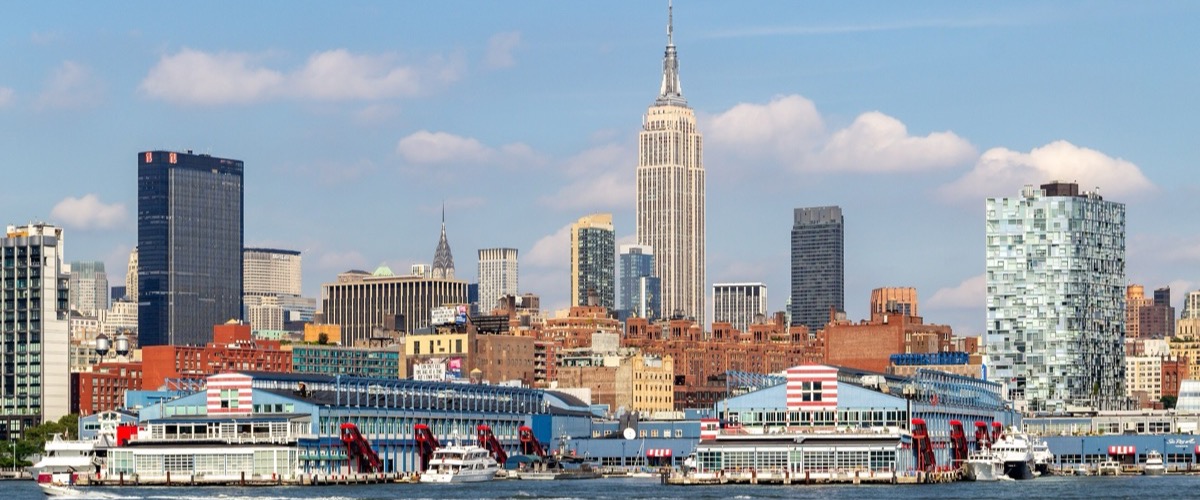
Downsizing in Manhattan
Manhattan is a borough of elevator buildings, row houses and thirty-two neighborhoods, and the differences between them show up in the details: the type of ownership, the subway line, the hospital network, the block. This page maps the borough, points to the neighborhoods with full guides and lists every one by community district.
- County
- New York County
- Community districts
- 12
- Common smaller homes
- Co-ops, condos, row house floors
- Evacuation zone
- Check by address
Manhattan at a glance
Manhattan is New York County, and NYC Planning divides it into 12 community districts. Their names run from Financial District-Tribeca in the south to Washington Heights-Inwood at the northern tip, and the neighborhoods inside them are very different places to live.
The waterfront is a large part of what the borough offers. Hudson River Park runs about four miles along the West Side, Central Park fills the land from 59th to 110th Street between Fifth Avenue and Central Park West, and Fort Tryon Park and Inwood Hill Park anchor the north. At the southern tip, NYC Parks notes that Castle Garden, inside The Battery, became what it calls the world's first immigrant depot in 1855.
Sources: NYC Planning community profiles; NYC Parks, Central Park; NYC Parks, The Battery; NYC Parks, Fort Tryon Park; NYC Parks, Inwood Hill Park; Hudson River Park Trust.
Co-ops, condos and row houses for Manhattan downsizers
Most people moving smaller in Manhattan choose between three formats, and each carries different paperwork and different day-to-day trade-offs.
- Co-op apartments. You buy shares in a corporation and receive a proprietary lease. The board's application, the building's financial requirements, any flip tax and the sublet policy come from the building's own documents, not from state law. Ask for the proprietary lease, bylaws and house rules early.
- Condominiums. You own a deeded unit plus an interest in the common elements, and common charges follow the declaration and bylaws. Whether the board has a right of first refusal depends on what those documents say.
- Row house floors and small houses. A floor of a converted row house can give you a single level and no lobby, but check the stoop, the stairs inside and the condition of the roof and systems.
The Landmarks Preservation Commission's Manhattan list runs to more than 80 historic districts and extensions, from Carnegie Hill and the Upper West Side to Greenwich Village, Chelsea, Murray Hill and Hamilton Heights. If a building you like sits inside one, exterior changes such as windows and facades go through that agency, so ask before you plan any work.
Some Manhattan co-ops are limited-equity cooperatives supervised by the city, where residents do not profit on resale and buyers come from waiting lists with income requirements. Penn South in Chelsea describes itself this way, so it is a different route from a market co-op purchase. Condo and co-op units are outside the state's Property Condition Disclosure Act, and New York City adopted a 2026 law setting deadlines for co-op boards, so ask your attorney whether it covers a given building. Compare formats in the co-op, condo, townhouse or house guide.
Sources: NY Attorney General, cooperatives; NY Attorney General, condominiums; NYC Landmarks Preservation Commission, Manhattan historic districts; Penn South FAQ; NY Real Property Law sec. 461.
Where to start: Manhattan neighborhoods with full guides
These neighborhoods each have their own page with housing, transit, hospitals and taxes worked through in detail.
- Upper West Side: co-ops and condos between Central Park and Riverside Park, with the 1 and C lines.
- Upper East Side: co-op and condo buildings between Central Park and the East River, near major hospitals.
- Battery Park City: waterfront condos and rentals on ground-leased land, with parks along the Hudson.
- Murray Hill and Kips Bay: East Side co-ops, condos and brownstones near the 6 train and Grand Central.
- Chelsea: West Side apartment complexes and landmarked row houses beside the High Line.
- Greenwich Village and West Village: historic districts, row houses and apartment buildings around Washington Square.
- Harlem: row houses, co-ops and condos in Central Harlem.
- Turtle Bay and Sutton Place: East Midtown co-ops and condos near Grand Central and the East River.
Getting around Manhattan without a car
The subway is the backbone. The MTA's line pages show the 1 making local stops from Marble Hill down to South Ferry, the C running local along Eighth Avenue and Central Park West, and the A and E serving the West Side and Midtown, with the A, C and E all stopping at W 4 St-Washington Sq. The F runs from East Midtown down to the Lower East Side, the L crosses 14th Street, and the 7 ends at 34 St-Hudson Yards. Elevator access differs by station, so check the MTA's accessible stations list for the ones you would use.
Three ferry services touch the borough. NYC Ferry's East River, Astoria, South Brooklyn and Rockaway-Soundview routes stop at Manhattan landings including Wall Street/Pier 11, East 34th Street and East 90th Street, and its St. George route stops at Midtown West/Pier 79 and Battery Park City/Vesey Street. NYC Ferry lists a $1.35 reduced fare for seniors.
For regional rail, Metro-North runs from Grand Central Terminal and Harlem-125th Street, and the Long Island Rail Road serves Penn Station and Grand Central Madison. The MTA's Reduced-Fare program offers riders 65 and older half the $3 base fare on subways, the Staten Island Railway and local buses, and up to 50% off peak one-way fares on LIRR and Metro-North; seniors who enroll in person get their card the same day. Our guide to getting around New York City after 65 covers the details. For any specific trip, use the MTA trip planner.
Sources: MTA, 1 line; MTA, C line; MTA, 7 line; MTA Reduced-Fare program; NYC Ferry routes and fares; MTA Metro-North; MTA Long Island Rail Road.
Hospitals and health care in Manhattan
Manhattan has several large academic medical centers, and which one makes sense depends on your doctors and insurer more than your address. Each of these lists round-the-clock emergency care on its own site:
- NewYork-Presbyterian/Weill Cornell Medical Center, 525 East 68th Street on the Upper East Side.
- NewYork-Presbyterian/Columbia University Irving Medical Center, 622 West 168th Street in Washington Heights.
- NewYork-Presbyterian Lower Manhattan Hospital, 170 William Street.
- The Mount Sinai Hospital, 1 Gustave L. Levy Place, and Mount Sinai West, 1000 Tenth Avenue.
- NYU Langone's Tisch Hospital, 550 First Avenue, with the Ronald O. Perelman Center for Emergency Services at 570 First Avenue.
- Northwell Greenwich Village Hospital, 30 Seventh Avenue, with a 24/7 emergency department.
Lenox Hill Hospital is at 100 East 77th Street, and Memorial Sloan Kettering's Memorial Hospital, at 1275 York Avenue, provides cancer care. Check that a hospital is in your plan's network before you let a map decide for you.
Sources: NewYork-Presbyterian, Weill Cornell; NewYork-Presbyterian, Columbia; NewYork-Presbyterian Lower Manhattan Hospital; Mount Sinai Hospital; Mount Sinai West; NYU Langone Tisch; Northwell Greenwich Village Hospital; Lenox Hill Hospital; Memorial Sloan Kettering.
Older adult services and libraries in Manhattan
NYC Aging lists more than 300 older adult centers and affiliated sites across the five boroughs, and membership is free for New Yorkers 60 and older. Use its service and activity finders to see the centers near an address, or call Aging Connect at 212-AGING-NYC (212-244-6469).
The Manhattan Borough President's office publishes a Senior Resource Guide with more than 100 options, including senior centers and naturally occurring retirement communities, and takes questions at 212-669-8300. The New York Public Library has branches throughout the borough, listed on its locations page. See the resources page for move managers, donation options and legal referrals.
Sources: NYC Aging, older adult centers; Manhattan Borough President, Senior Resource Guide; NYPL locations.
Flooding, storms and insurance in Manhattan
Risk varies block by block, and it is not a borough-wide question. New York City ranks addresses into six hurricane evacuation zones by storm surge risk, with zone 1 the most likely to flood, and the city advises checking yours before a storm. FEMA's flood maps are a separate tool that drives insurance requirements. Look up any address on the city's evacuation zone finder and the FEMA Flood Map Service Center.
For Hurricane Sandy in 2012, the city's own report recorded a storm tide at the Battery of more than 14 feet above mean lower low water, against a previous record of about 10 feet. FloodHelpNY, a nonprofit program run by the Center for NYC Neighborhoods, names Lower Manhattan among the areas eligible for its free home resiliency audits and sewer backwater valve program for eligible homeowners, so check whether an address qualifies. Standard condo and co-op policies exclude flood; read our flood and storm insurance guide and ask the managing agent what the building's policy covers. Learn more from NYC Emergency Management.
Sources: NYC Emergency Management, hurricane evacuation; NYC, A Stronger, More Resilient New York, ch. 1; FloodHelpNY.
Taxes and senior relief in Manhattan
The same city and state programs apply across the borough, because every Manhattan address is in New York City.
- SCHE. The Senior Citizen Homeowners' Exemption requires age 65 or older, a primary residence and combined income of $58,399 or less. It reduces assessed value by 50% down to 5% on a sliding scale and is renewed every two years; co-op owners apply through a separate process. The city's 311 page for 2026/27 showed a March 16, 2026 deadline, so check the current date.
- Enhanced STAR. For owners 65 and older with income of $110,750 or less for 2026-27. In New York City it applies partly to city taxes, and co-op shareholders should ask the managing agent how they receive it.
- Co-op and condo abatement. The board applies for the whole building by February 15 each year, and owners certify that the unit is a primary residence.
Selling has its own costs, including the New York City Real Property Transfer Tax at 1% of the price up to $500,000 and 1.425% above, plus the state transfer tax. The city has also begun notifying owners about a new pied-a-terre surcharge that applies to one- to three-family homes, condos and co-ops when the owner has a separate primary residence; ask a CPA if you plan to keep a second Manhattan home. See costs and money and the net proceeds calculator. This is general information, not tax advice.
Sources: NYC311, SCHE; NYS Tax, STAR; NYC Finance, co-op and condo abatement; NYC Finance, RPTT; NYC Mayor's Office, pied-a-terre surcharge notice.
Every Manhattan neighborhood, by community district
The list below follows NYC Planning's neighborhood boundaries. Neighborhoods with a full guide on this site are linked and tagged, and each district links to its NYC Planning profile.
Community District 1: Financial District-Tribeca
- Financial District-Battery Park City Full guide
- Tribeca-Civic Center
Community District 2: Greenwich Village-SoHo
- SoHo-Little Italy-Hudson Square
- Greenwich Village Full guide
- West Village Full guide
Community District 3: Lower East Side-Chinatown
- Chinatown-Two Bridges
- Lower East Side
- East Village
Community District 4: Chelsea-Hell's Kitchen
- Chelsea-Hudson Yards Full guide
- Hell's Kitchen
Community District 5: Midtown-Flatiron-Union Square
- Midtown South-Flatiron-Union Square
- Midtown-Times Square
Community District 6: East Midtown-Murray Hill
- Stuyvesant Town-Peter Cooper Village
- Gramercy
- Murray Hill-Kips Bay Full guide
- East Midtown-Turtle Bay Full guide
Community District 7: Upper West Side
- Upper West Side-Lincoln Square Full guide
- Upper West Side (Central) Full guide
- Upper West Side-Manhattan Valley Full guide
Community District 8: Upper East Side-Roosevelt Island
- Upper East Side-Lenox Hill-Roosevelt Island Full guide
- Upper East Side-Carnegie Hill Full guide
- Upper East Side-Yorkville Full guide
Community District 9: Morningside Heights-Hamilton Heights
- Morningside Heights
- Manhattanville-West Harlem
- Hamilton Heights-Sugar Hill
Community District 10: Harlem
- Harlem (South) Full guide
- Harlem (North) Full guide
Community District 11: East Harlem
- East Harlem (South)
- East Harlem (North)
Community District 12: Washington Heights-Inwood
- Washington Heights (South)
- Washington Heights (North)
- Inwood
Next steps for a Manhattan move
Start with the step-by-step downsizing guide, then compare boroughs on the neighborhoods page. Introductions through this site go to agents on the operating team at eXp Realty, so this is not a search of the whole market. If you would like one, get matched with a downsizing specialist.
Questions people ask
Is it easier to downsize into a co-op or a condo in Manhattan?
Neither is automatically easier; they work differently. A co-op purchase is shares in a corporation plus a proprietary lease, and the building sets its own financial rules, sublet policy and any flip tax. A condo is a deeded unit governed by its declaration and bylaws. Neither is covered by the state's seller disclosure form, so the offering plan, financial statements and minutes matter more. Read our co-op and condo guide before you tour.
How many neighborhoods does Manhattan have?
NYC Planning's neighborhood boundaries divide Manhattan into 32 neighborhoods across 12 community districts. The directory on this page lists each one by district, and the neighborhoods that have a full guide on this site are linked.
Can I use the reduced-fare MetroCard or OMNY program in Manhattan?
The MTA's Reduced-Fare program is open to riders 65 and older. It covers subways, the Staten Island Railway and local buses at half the base fare, and the MTA says people 65 and older can enroll in person and get a card the same day. See our guide to getting around New York City after 65 for the rest of the picture.
Which senior property tax breaks apply in Manhattan?
Manhattan is part of New York City, so the city's Senior Citizen Homeowners' Exemption (SCHE), Enhanced STAR and, for co-op and condo owners, the primary-residence tax abatement can apply, each with its own age, income and residency tests. The senior exemptions guide walks through them.
Does the whole borough flood in a big storm?
No, and no single answer covers the borough. The city ranks addresses into six evacuation zones by storm surge risk, and FEMA's flood maps are a different tool used for insurance. Check any address you are considering on both, and ask the managing agent what a building's policy covers.
The other boroughs
- BrooklynKings County: brownstone rows, two-family houses, co-ops and a long waterfront.
- QueensCo-ops, garden apartments and houses across 14 community districts.
- The BronxCo-op City, Parkchester, Riverdale, Pelham Parkway and Throgs Neck.
- Staten IslandHouses and attached homes across 3 community districts, with the ferry and the SIR.
Talk it through with a local downsizing specialist
We can introduce you to a licensed New York area agent with eXp Realty who works with homeowners moving to less house. New York Downsizing is operated by licensed agents affiliated with eXp Realty and is not a New York brokerage.