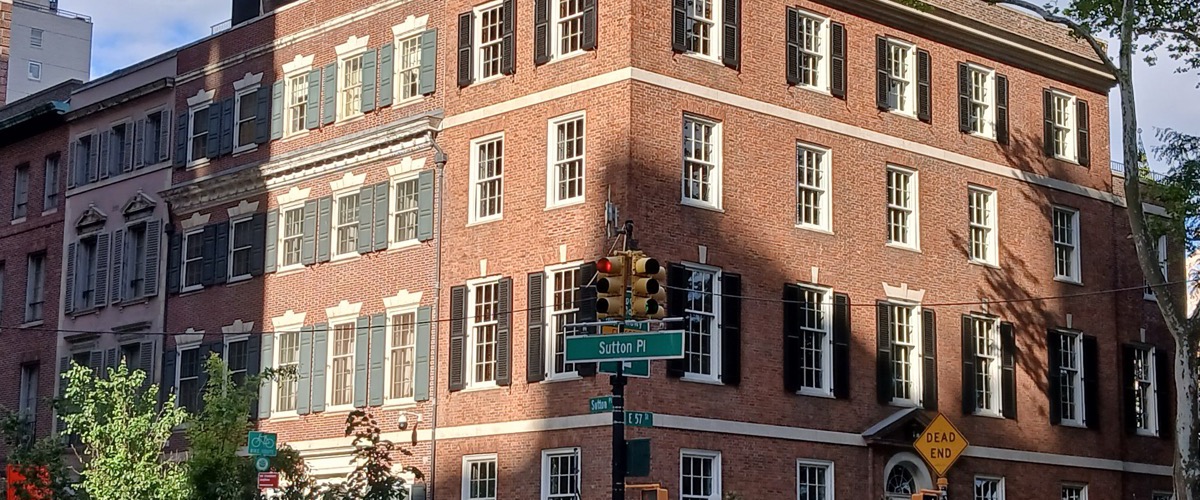
Downsizing in Turtle Bay and Sutton Place
This stretch of the East Side runs from the United Nations area up to Sutton Place along the East River, with Grand Central and the Lexington Avenue subway on its west side. This page covers the housing types, transit, hospitals, storm questions and taxes to weigh when you move from a larger home into an apartment here.
- Local government
- City of New York (New York County, Community District 6)
- Smaller-home types
- Co-ops, condos, townhouse apartments
- Nearby hospitals
- Bellevue Hospital Center and NYU Langone Tisch Hospital
- Evacuation zone
- Check by address
Turtle Bay, Sutton Place and Beekman at a glance
Manhattan Community Board 6 covers the East Side from 14th to 59th Streets, and its own needs statement lists Turtle Bay, Sutton Place, Beekman Place and Tudor City among the district's neighborhoods, along with the United Nations.
The name comes from a cove of the East River that ran from 45th to 48th Street. The Landmarks Preservation Commission's 1966 report says the cove was long ago filled in and that the name was in common use in wills and deeds by 1712.
Sources: Manhattan Community Board 6, statement of district needs; LPC, Turtle Bay Gardens designation report.
Co-ops, condos and townhouse apartments in East Midtown
The choice here is usually between an apartment in an elevator building, prewar or postwar, and a floor of an older townhouse. Co-ops and condos both exist, and the type changes building by building. The trade-offs by type:
- Co-op apartments. You buy shares in a corporation and receive a proprietary lease. The board application, financial rules, any flip tax and the sublet policy come from the building's own documents, not from state law.
- Condominiums. You own a deeded unit plus a share of the common elements. Common charges follow the declaration and bylaws, and a board right of first refusal exists only if those documents provide it.
- Townhouse floors. A converted row house can give you a quiet address with no lobby, but many have stairs and no elevator.
Ownership type is a building-by-building fact, so confirm it in the offering plan rather than assuming it from an address. The state Attorney General regulates offering plans for co-ops and condos. Condos and co-ops are outside the state's Property Condition Disclosure Act, so the offering plan, financial statements and board minutes carry more weight than a seller's form. New York City also adopted a 2026 law setting deadlines for co-op boards to act on applications; ask your attorney whether it covers a given building. Compare formats in our co-op, condo, townhouse or house guide.
Historic districts
The LPC's Manhattan list includes the Turtle Bay Gardens Historic District, designated June 21, 1966. Its twenty houses on East 48th and 49th Streets share a garden with a central esplanade. The Tudor City Historic District, designated in 1988, covers the Tudor Revival apartment complex between First and Second Avenues and 40th and 43rd Streets. Rules for exterior changes follow the address.
Sources: LPC, Manhattan historic districts; LPC, Turtle Bay Gardens report; Historic Districts Council, Tudor City; NY Real Property Law sec. 461; NY Attorney General, cooperatives.
Getting around Turtle Bay and Sutton Place
Grand Central-42 St has the 4, 5, 6 and 7. The MTA marks it accessible. The 6 also stops at 51 St, which the MTA lists as accessible, and at 59 St, where the 4, 5, N, R and W also stop. The E stops at Lexington Av/53 St, an accessible express station with a transfer to the 6. Accessibility at 59 St is limited, so check the MTA accessible stations list before relying on it.
Grand Central Terminal serves Metro-North's Harlem, Hudson and New Haven lines and connects to the M1, M2, M3, M4, M42, M101, M102 and M103 buses. Grand Central Madison, with entrances around 45th, 47th and 48th Streets, serves the Long Island Rail Road. For a specific trip, use the MTA trip planner, and see our guide to getting around New York City after 65.
Sources: MTA, 4 line; MTA, 6 line; MTA, 7 line; MTA, E line; MTA, Grand Central Terminal; MTA, Grand Central Madison.
Hospitals and health care near East Midtown
The city Health Department's list of Manhattan emergency departments includes Bellevue Hospital Center at 462 First Avenue, NYU Langone Tisch Hospital at 550 First Avenue and NewYork-Presbyterian/Weill Cornell Medical Center at 525 East 68th Street. Lenox Hill Hospital at 100 East 77th Street is on the same list. Community Board 6's needs statement also names Bellevue, NYU Langone and the VA Medical Center among the district's medical facilities. Check which hospitals and specialists your insurance and doctors use before letting a map decide for you.
Sources: NYC Health Department, emergency departments; Manhattan Community Board 6.
Parks, libraries and everyday life in East Midtown
- Small East River parks. Community Board 6's budget requests name Peter Detmold Park at 454 East 51st Street, Sutton Place Park on the East River, Dag Hammarskjold Plaza and Ralph J. Bunche Park. Check NYC Parks for hours and features.
- Library. The New York Public Library's Grand Central branch is at 135 East 46th Street. Find other branches in the NYPL location finder.
- The United Nations. The UN headquarters is in the district, and the community board says the area is also home to hundreds of missions and diplomatic residences, which shapes the street life around First Avenue.
- Older adult programs. NYC Aging lets you find a center near you; membership at its older adult centers is free for people 60 and older.
Sources: Manhattan Community Board 6; NYC Aging older adult centers.
Storms, flooding and insurance in Turtle Bay and Sutton Place
Flood and evacuation risk differ by block, and the two maps measure different things. New York City's evacuation zones rank storm surge risk, while FEMA flood maps drive insurance requirements. Community Board 6's needs statement refers to Superstorm Sandy flood damage in the district and to a waterfront resiliency project, so a block near the East River deserves a careful look. Look up any address in the city's hurricane evacuation zone finder and on the FEMA Flood Map Service Center. Standard condo and co-op policies exclude flood, and a unit owner's policy generally covers the interior and contents while the association's policy covers the structure. Read our flood and storm insurance guide and ask the managing agent what the building's policy covers.
Taxes and local government in Turtle Bay and Sutton Place
This area is in the City of New York and New York County, so the property tax bill and exemptions come from the city's Department of Finance. Three programs are worth checking:
- SCHE. The Senior Citizen Homeowners' Exemption requires age 65 or older, a primary residence and combined owner income of $58,399 or less, and reduces assessed value by 50% down to 5% on a sliding scale. Co-op owners apply through a separate process. The city's 311 page for the 2026/27 cycle showed a March 16, 2026 deadline; check the current date.
- Enhanced STAR. For owners 65 and older with income of $110,750 or less for 2026-27, it applies mainly to school taxes and, in New York City, partly to city taxes. Ask the managing agent how co-op shareholders receive it.
- Co-op and condo abatement. The board applies for the whole building by February 15 each year, and owners certify that the unit is a primary residence.
Selling has its own costs, including the NYC Real Property Transfer Tax at 1% of the price up to $500,000 and 1.425% above. See costs and money and the net proceeds calculator. This is general information, not tax advice.
Sources: NYC311, SCHE; NYS Tax, STAR; NYC Finance, co-op and condo abatement; NYC Finance, RPTT.
Questions to ask before you buy in Turtle Bay or Sutton Place
- Is the apartment a co-op or a condo, and what does the offering plan say? Ask for the plan, financial statements and recent board minutes.
- For a co-op, what does the board package require, how long does approval usually take and is there a flip tax? Flip taxes are set by each building, so ask for the amount in writing.
- What are the sublet and pied-a-terre rules, and can you rent the apartment out if you later move to care?
- If the building is prewar, what has been replaced in the plumbing, wiring and elevators? If it is postwar, what do the ceiling heights, layouts and window types look like in person?
- How many steps are there from the street to the elevator and from the elevator to the door?
- What are the building's reserves, its underlying mortgage and any planned assessments?
- Is the building inside a landmark district, and does that limit window, terrace or facade changes?
- Which subway station or Grand Central line would you use, and is it on the MTA's accessible list?
Compare this with Murray Hill and Kips Bay and the Upper East Side, browse all neighborhoods or start with the step-by-step downsizing guide. Introductions through this site go to agents on the operating team at eXp Realty, so this is not a search of the whole market. If you want one, get matched with a downsizing specialist.
Questions people ask
Are Turtle Bay and Sutton Place apartments mostly co-ops or condos?
Both exist, and the split varies building by building. The type changes what you sign and how a sale works, so ask the listing agent early, then read the co-op and condo guide.
Are there historic districts in East Midtown?
The Landmarks Preservation Commission lists the Turtle Bay Gardens Historic District, twenty houses on East 48th and 49th Streets that share a garden, and the Tudor City Historic District between First and Second Avenues. Whether a specific building is inside a district affects exterior work, so ask before you plan renovations.
Which trains serve Turtle Bay and Sutton Place?
The MTA's line pages show the 4, 5, 6 and 7 at Grand Central-42 St, the 6 at 51 St and 59 St, the 4 and 5 at 59 St and the E at Lexington Av/53 St. Grand Central Terminal also has Metro-North's Harlem, Hudson and New Haven lines, and Grand Central Madison serves the Long Island Rail Road. Check accessibility at the station you would use.
What senior tax relief applies in East Midtown?
East Midtown is in New York City, so owners can look at the city's Senior Citizen Homeowners' Exemption (SCHE), Enhanced STAR and, for co-op and condo owners, the primary-residence abatement the building applies for. Each has age, income and residency tests, described below and in the senior exemptions guide.
More neighborhoods to compare
- Upper West SideCo-ops and condos between Central Park and Riverside Park, with the 1 and C lines.
- Upper East SideCo-op and condo buildings between Central Park and the East River, near major hospitals.
- Battery Park CityWaterfront condos and rentals on ground-leased land, with parks and a resilience build-out.
- Murray Hill and Kips BayEast Side co-ops, condos and brownstones near the 6 train, Grand Central and NYU Langone.
- ChelseaLandmarked row houses and large West Side co-op complexes beside the High Line.
- Greenwich Village and West VillageHistoric districts, row houses and apartment buildings around Washington Square Park.
Talk it through with a local downsizing specialist
We can introduce you to a licensed New York area agent with eXp Realty who works with homeowners moving to less house. New York Downsizing is operated by licensed agents affiliated with eXp Realty and is not a New York brokerage.