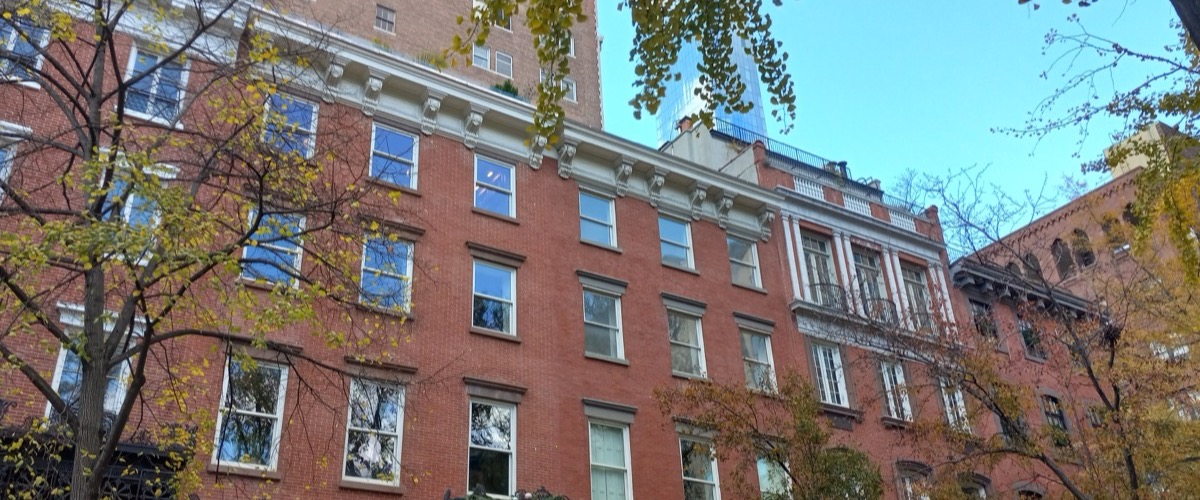
Downsizing in Gramercy
Gramercy is centered on a locked private park, with historic districts around it and the 6 and the L within reach. This page covers what the park does and does not mean for a buyer, along with housing, transit, hospitals, flood questions and taxes if you are moving from a larger home into a smaller one here.
- Local government
- City of New York (New York County, Community District 6)
- Smaller-home types
- Co-ops, condos, row-house apartments
- Nearby hospitals
- Bellevue Hospital Center; NYU Langone Tisch
- Evacuation zone
- Check by address
Gramercy at a glance
NYC Planning's Gramercy neighborhood is in Manhattan Community District 6, with Stuyvesant Town-Peter Cooper Village and Murray Hill-Kips Bay as separate neighbors. The community board describes its district as the east side from 14th to 59th Streets, from the East River to Lexington Avenue. Union Square Park, at East 14th to 17th Streets, and Stuyvesant Square, from East 15th to 17th Streets, are nearby.
The neighborhood grew around a park. According to the Gramercy Park Block Association, Samuel B. Ruggles conveyed the park to five trustees by an indenture dated December 17, 1831. That deed still governs it. The Trustees, the Block Association says, have sole responsibility for the garden's maintenance and security.
Sources: Gramercy Park Block Association, history; GPBA, sources and original documents; Manhattan Community Board 6; NYC Parks, Union Square Park.
What the private Gramercy Park means if you buy here
Gramercy Park is a private garden, not a public park. The Block Association's history says the 1831 indenture tied sixty numbered lots to the park's upkeep, and that a confirmatory deed of December 24, 1833 established the garden's use as an easement belonging to those properties. The garden is cared for by the Trustees of Gramercy Park, who are separate from the Block Association, which does community work such as street cleaning and tree care.
For a buyer, the practical point is that the park comes through the deed and the Trustees, not through the neighborhood. Listings sometimes mention a key. Do not rely on that line. Ask the seller and the managing agent in writing whether the specific apartment has a key, how it is assigned, whether it transfers on sale and what it costs, and ask the Trustees to confirm. The terms are theirs to state; this page does not give a number.
Sources: Gramercy Park Block Association, history; GPBA, about us.
Co-ops, condos and row-house apartments in Gramercy
The LPC's Manhattan list includes the Gramercy Park Historic District and its extension, along with the Stuyvesant Square Historic District, and the Block Association links the LPC reports from 1966 and 1988. The mix around the park includes row houses and apartment buildings, and the choices for a smaller home come down to ownership type:
- Co-op apartments. You buy shares and receive a proprietary lease. The board package, financial rules, any flip tax and the sublet policy come from the building's documents, not state law. New York City adopted a 2026 law setting deadlines for co-op boards to act on applications; ask your attorney whether it covers a given building.
- Condominiums. You own a deeded unit plus a share of the common elements. A board right of first refusal exists only if the declaration provides it.
- Apartments in converted row houses. These can mean a few flights of stairs and no elevator. Count the steps.
Because the offering plan and financial statements matter, have an attorney read them. Landmark rules apply to exteriors if the building is in a district. Compare formats in our co-op and condo buying guide.
Sources: LPC, Manhattan historic districts; NY Attorney General, cooperatives; NY Real Property Law sec. 461.
Getting around Gramercy
The 6 is the local line on this side. The MTA's 6 line page shows 14 St-Union Sq (with the L, N, Q, R and W, weekday for the W, and the 4 and 5 except late nights), 23 St (accessible), 28 St (accessible southbound only) and 33 St. The L stops at 14 St-Union Sq, which the MTA marks accessible for the L, and at 3 Av, which it does not mark accessible.
Test the walk from your block to the station you would use, check the MTA accessible stations list and try trips in the MTA trip planner. See also our guide to getting around New York City after 65.
Sources: MTA, 6 line; MTA, L line.
Hospitals and health care near Gramercy
The city Health Department's list of Manhattan emergency departments includes Bellevue Hospital Center at 462 First Avenue and NYU Langone Tisch Hospital at 550 First Avenue, both east of the neighborhood. Check which hospitals and doctors your insurance covers before letting a map decide for you.
Sources: NYC Health Department, emergency departments.
Parks, libraries and everyday life in Gramercy
- Union Square Park. NYC Parks lists it from Broadway to 4th Avenue and East 14th to 17th Streets. It opened in 1839, was redesigned in 1872 by Frederick Law Olmsted and Calvert Vaux, and hosts the Greenmarket.
- Stuyvesant Square. A park from Rutherford Place to Nathan D. Perlman Place, East 15th to 17th Streets, named for Peter Gerard Stuyvesant, with dog-friendly areas.
- Libraries and older adult programs. Find the nearest branch in the NYPL location finder, and use NYC Aging to find a center near you; membership at its older adult centers is free for people 60 and older.
Sources: NYC Parks, Union Square Park; Stuyvesant Square; NYC Aging older adult centers.
Storms, flooding and insurance in Gramercy
Flood and evacuation risk differ by block, and the two maps measure different things. New York City's evacuation zones rank storm surge risk, while FEMA flood maps drive insurance requirements. Look up any address in the city's hurricane evacuation zone finder and on the FEMA Flood Map Service Center. Standard homeowner, condo and co-op policies exclude flood, and a unit owner's policy generally covers the interior and contents while the association's policy covers the structure. Read our flood and storm insurance guide and ask the managing agent what the building's policy covers.
Taxes and local government in Gramercy
Gramercy is in the City of New York and New York County, so the property tax bill and exemptions come from the city's Department of Finance. Three programs are worth checking:
- SCHE. The Senior Citizen Homeowners' Exemption requires age 65 or older, a primary residence and combined owner income of $58,399 or less, and reduces assessed value by 50% down to 5% on a sliding scale. Co-op owners apply through a separate process. The city's 311 page for the 2026/27 cycle showed a March 16, 2026 deadline; check the current date.
- Enhanced STAR. For owners 65 and older with income of $110,750 or less for 2026-27, it applies mainly to school taxes and, in New York City, partly to city taxes. Ask the managing agent how co-op shareholders receive it.
- Co-op and condo abatement. The board applies for the whole building by February 15 each year, and owners certify that the unit is a primary residence.
Selling has its own costs, including the NYC Real Property Transfer Tax at 1% of the price up to $500,000 and 1.425% above. See costs and money and the net proceeds calculator. This is general information, not tax advice.
Sources: NYC311, SCHE; NYS Tax, STAR; NYC Finance, co-op and condo abatement; NYC Finance, RPTT.
Questions to ask before you buy in Gramercy
- Does the apartment come with a key to Gramercy Park? If so, how is it assigned, what does it cost and does it transfer on sale? Ask in writing.
- For a co-op, what does the board package require, how long does approval usually take and is there a flip tax? Get the amount in writing.
- Is the building inside a historic district, and what does that mean for windows, terraces or facade work?
- Is there an elevator, and how many steps lead from the street to your door?
- For a condo, does the declaration give the board a right of first refusal?
- Which station would you use, and is it on the MTA accessible list?
- What are the building's reserves, underlying mortgage and any planned assessments?
Compare this with Murray Hill and Kips Bay and Greenwich Village. Browse all neighborhoods or start with the step-by-step downsizing guide. Introductions through this site go to agents on the operating team at eXp Realty, so this is not a search of the whole market. If you want one, get matched with a downsizing specialist.
Questions people ask
Is Gramercy Park open to the public?
No. The Gramercy Park Block Association describes it as a private garden cared for by the Trustees of Gramercy Park under an 1831 deed. Samuel B. Ruggles conveyed it to five trustees on December 17, 1831. A confirmatory deed dated December 24, 1833 established its use as an easement belonging to the surrounding lots. Living nearby does not by itself give you access.
Does buying an apartment near the park come with a key?
Not automatically. Access to the park runs through the Trustees and through the lots the 1831 deed ties to the garden. If a key matters to you, ask the seller and the building's managing agent whether the apartment has one, and ask the Trustees how keys are assigned, before you sign anything. Get the answer in writing.
Are there historic districts in Gramercy?
Yes. The Landmarks Preservation Commission lists the Gramercy Park Historic District and its extension, and the Gramercy Park Block Association's history page links the 1966 and 1988 designation reports. The Stuyvesant Square Historic District is also on the LPC's Manhattan list. If a building is inside one, exterior work goes through the LPC.
What senior tax relief applies in Gramercy?
The area is in New York City, so owners can look at the Senior Citizen Homeowners' Exemption (SCHE), Enhanced STAR and, for co-op and condo owners, the primary-residence abatement the building applies for. Each has age, income and residency tests, laid out below and in the senior exemptions guide.
More neighborhoods to compare
- Upper West SideCo-ops and condos between Central Park and Riverside Park, with the 1 and C lines.
- Upper East SideCo-op and condo buildings between Central Park and the East River, near major hospitals.
- Battery Park CityWaterfront condos and rentals on ground-leased land, with parks and a resilience build-out.
- Murray Hill and Kips BayEast Side co-ops, condos and brownstones near the 6 train, Grand Central and NYU Langone.
- ChelseaLandmarked row houses and large West Side co-op complexes beside the High Line.
- Greenwich Village and West VillageHistoric districts, row houses and apartment buildings around Washington Square Park.
Plan your move
We can introduce you to a licensed New York area agent with eXp Realty who works with homeowners moving to less house. New York Downsizing is operated by licensed agents affiliated with eXp Realty and is not a New York brokerage.