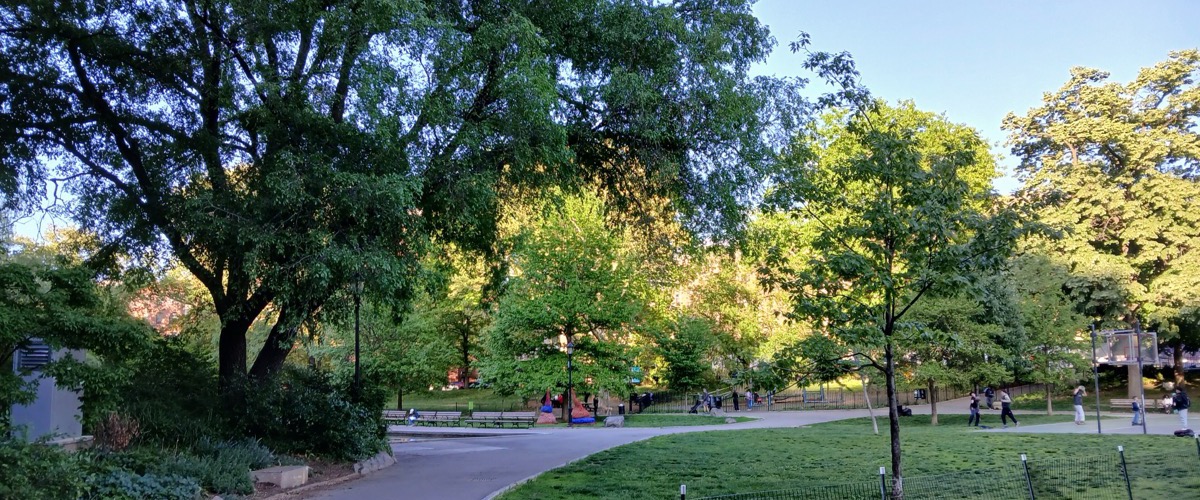
Downsizing in Morningside Heights
Morningside Heights is a Manhattan neighborhood of prewar apartment buildings on a plateau between Riverside Park and Morningside Park, with Columbia University, Barnard College and several other institutions as neighbors. It is mostly an apartment market, and ownership type varies building by building.
- Local government
- City of New York (New York County, Community District 9)
- Home types
- Apartment buildings; ask about ownership type
- Nearest hospital
- Mount Sinai Morningside
- Evacuation zone
- Check by address
Morningside Heights at a glance
Manhattan Community Board 9 covers Hamilton Heights, Manhattanville, Morningside Heights and a small part of Central Harlem, running from 110th Street to 155th Street. It describes Morningside Heights as home to Columbia University, Barnard College, seminaries, Riverside Church and other institutions, and says the neighborhood is anchored at its northern end by the General Grant Houses and the former limited-equity cooperative Morningside Gardens.
The Landmarks Preservation Commission (LPC) explains the history. The area stayed largely undeveloped through the 19th century, and the sale of two institutional parcels in the 1890s to Columbia University and the Cathedral Church of St. John the Divine began its transformation. The IRT subway reached Broadway in 1904, and developers then filled the plateau with apartment houses.
Sources: Manhattan Community Board 9, FY2026 statement; LPC, Morningside Heights Historic District report.
Apartment buildings on Riverside Drive, Broadway and the side streets
The LPC report says smaller buildings joined existing row houses on the side streets, while larger apartment buildings filled the main thoroughfares: Cathedral Parkway, Riverside Drive, Claremont Avenue, Broadway and West 116th Street. It counts about 115 residential and institutional buildings in the district, says another 69 apartment buildings had been added by 1911 after the first small ones in 1903, and describes the apartment buildings as designed in a range of revival styles. In May 2017 the City Council removed one property, 550 Cathedral Parkway, from the boundaries.
Who owns what matters more here than in most places. Community Board 9 says most real estate is held by institutions, with the remaining parcels generally in private co-ops and a small group of rent-stabilized rentals. It gives no split, and neither does this page. For any building, ask whether it is a co-op, a condominium, an institution-owned rental or a rental, and get the answer in writing. Do not assume a building is a co-op because its neighbors are.
- Co-ops. You buy shares and a proprietary lease. The board application, financial rules and any flip tax come from the building's documents.
- Condominiums. You own a deeded unit. Common charges follow the declaration, and a right of first refusal exists only if the documents provide one.
- Rentals. If a building turns out to be a rental, it is not a purchase. Ask before you spend time touring.
Neither co-ops nor condos are covered by the state's seller disclosure statement, so the offering plan, financial statements and board minutes carry the weight. New York City also adopted a 2026 law on how quickly co-op boards must respond to applications; ask your attorney whether it applies to a given building. Our co-op and condo buying guide lists the documents to request.
Sources: LPC, Morningside Heights report; Community Board 9; NY Attorney General, cooperatives; NY Real Property Law sec. 461.
Getting around Morningside Heights
The 1 runs under Broadway. The MTA lists Cathedral Pkwy (110 St), 116 St-Columbia University and 125 St on that line, with an M60 SBS bus connection to the airport at 116 St. The MTA does not list any of those three stations as accessible. The nearest accessible station it lists on the 1 here is 137 St-City College. The C stops at 110 St-Cathedral Pkwy and 116 St, with the B as a weekday transfer until 11 p.m., and the MTA does not list those as accessible either.
Because the hillside is steep, check the route from a building to its station as well as the station. Use the MTA trip planner for buses, and see our guide to getting around New York City after 65.
Sources: MTA, 1 line; MTA, C line.
Hospitals and health care near Morningside Heights
The city Health Department's list of Manhattan emergency departments includes Mount Sinai Morningside at 1111 Amsterdam Avenue, with an emergency department, cardiac surgery and primary care among its listed services. See Mount Sinai's own page for departments and visiting hours. Check which hospitals your doctors and plan use before you let proximity decide.
Source: NYC Health Department, emergency departments.
Riverside Park, Morningside Park and everyday life in Morningside Heights
- Riverside Park. NYC Parks describes a landscape by Frederick Law Olmsted that terraces down from Riverside Drive to the Hudson River, and lists it as one of the city's scenic landmarks. A drainage reconstruction between 108th and 116th Streets appears on its project list.
- Morningside Park. It runs from West 110th to West 123rd Street between Manhattan and Morningside Avenues. NYC Parks lists staircase reconstruction projects at 114th, 116th and 122nd Streets, a reminder that the park is built on a slope.
- Libraries. The New York Public Library has branches in and around the neighborhood; find the nearest in the NYPL location finder.
- Older adult programs. NYC Aging lets you find a center near you.
Sources: NYC Parks, Riverside Park; NYC Parks, Morningside Park.
Storms, flooding and insurance in Morningside Heights
Flood and evacuation risk differ by block, and the two maps measure different things. New York City's evacuation zones rank storm surge risk, while FEMA flood maps drive insurance requirements. Look up any address in the city's hurricane evacuation zone finder and on the FEMA Flood Map Service Center. Standard condo and co-op policies exclude flood, and the association's policy covers the structure. Read our flood and storm insurance guide.
Taxes and local government in Morningside Heights
Morningside Heights is in the City of New York and New York County, so the property tax bill and exemptions come from the city's Department of Finance. Three programs are worth checking:
- SCHE. The Senior Citizen Homeowners' Exemption requires age 65 or older, a primary residence and combined owner income of $58,399 or less, and reduces assessed value by 50% down to 5% on a sliding scale. Co-op owners apply separately. The 311 page for 2026/27 showed a March 16, 2026 deadline; check the current date.
- Enhanced STAR. For owners 65 and older with income of $110,750 or less for 2026-27. Ask the managing agent how co-op shareholders receive it.
- Co-op and condo abatement. The board applies for the whole building by February 15 each year, and owners certify that the unit is a primary residence.
Selling adds the NYC Real Property Transfer Tax at 1% of the price up to $500,000 and 1.425% above. See costs and money and the net proceeds calculator. This is general information, not tax advice.
Sources: NYC311, SCHE; NYS Tax, STAR; NYC Finance, abatement; NYC Finance, RPTT.
Questions to ask before you buy in Morningside Heights
- Is the building a co-op, a condominium or an institution-owned rental, and what document shows it?
- For a co-op, what does the board package require, how long does approval take and is there a flip tax? Flip taxes are set by each building.
- Is the building inside the Morningside Heights Historic District, and what does that mean for windows or facade work?
- Is there an elevator, and how many steps lead from the street to the lobby?
- How steep is the walk to the nearest subway station, and is that station on the MTA's accessible list?
- What are the building's reserves, underlying mortgage and any planned assessments?
- For a condo, does the declaration give the board a right of first refusal?
Compare this with the Upper West Side and Harlem, browse downsizing in Manhattan or start with the step-by-step downsizing guide. Introductions through this site go to agents on the operating team at eXp Realty, so this is not a search of the whole market. If you want one, get matched with a downsizing specialist.
Questions people ask
Who owns the buildings in Morningside Heights?
Manhattan Community Board 9 says real estate in Morningside Heights is overwhelmingly owned by the area's institutions, and that the remaining parcels generally belong to private co-ops, plus a small cluster of rent-stabilized rental buildings near Tiemann Place, La Salle Street and Claremont Avenue. That is the board's description, not a count, so check the ownership type of each building you tour before you assume.
Is Morningside Heights a historic district?
Part of it is. The Landmarks Preservation Commission designated the Morningside Heights Historic District on February 21, 2017. On May 24, 2017 the City Council removed one property, 550 Cathedral Parkway, from it. The designation report describes a district of apartment buildings that went up after the IRT subway arrived in 1904. Ask whether a specific address is inside the boundary before planning exterior work.
Are the 1 train stations step-free?
The MTA's 1 line map does not list Cathedral Pkwy (110 St), 116 St-Columbia University or 125 St as accessible. The nearest accessible 1 station it lists on that stretch is 137 St-City College. If stairs matter to you, check each station on the MTA site and look at the C and B at 110 St and 116 St, since those are not listed as accessible either.
What senior tax relief applies in Morningside Heights?
The area is in New York City, so owners can look at the Senior Citizen Homeowners' Exemption, Enhanced STAR and, for co-op and condo owners, the primary-residence abatement the building applies for. Each has age, income and residency tests, laid out below and in the senior exemptions guide.
More neighborhoods to compare
- Upper West SideCo-ops and condos between Central Park and Riverside Park, with the 1 and C lines.
- Upper East SideCo-op and condo buildings between Central Park and the East River, near major hospitals.
- Battery Park CityWaterfront condos and rentals on ground-leased land, with parks and a resilience build-out.
- Murray Hill and Kips BayEast Side co-ops, condos and brownstones near the 6 train, Grand Central and NYU Langone.
- ChelseaLandmarked row houses and large West Side co-op complexes beside the High Line.
- Greenwich Village and West VillageHistoric districts, row houses and apartment buildings around Washington Square Park.
Plan your move
We can introduce you to a licensed New York area agent with eXp Realty who works with homeowners moving to less house. New York Downsizing is operated by licensed agents affiliated with eXp Realty and is not a New York brokerage.