Downsizing in Carroll Gardens and Cobble Hill, Brooklyn
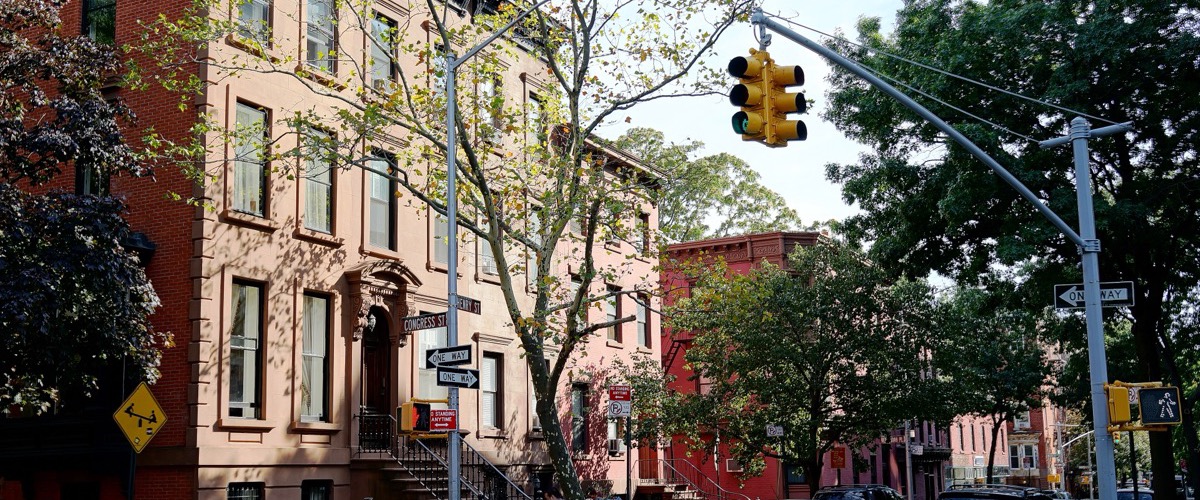
Carroll Gardens and Cobble Hill are two Kings County neighborhoods of landmarked brownstone and brick blocks, side by side south of Atlantic Avenue. For someone moving smaller, the questions are stairs, the type of building and how much of the neighborhood's history comes with rules about the exterior.
- Local government
- City of New York, Kings County
- Smaller-home types
- Co-ops, condos, row houses
- Nearest hospital
- NYU Langone emergency department, Cobble Hill
- Evacuation zone
- Check by address
Carroll Gardens and Cobble Hill at a glance
The Landmarks Preservation Commission designated the Cobble Hill Historic District on December 30, 1969. Its report describes more than 22 blocks generally between Atlantic Avenue, Court, Degraw and Hicks Streets, a southern extension of the Brooklyn Heights district. Residential development began in the mid-1830s with a row of Greek Revival town houses, and the report says commercial areas were largely limited to Atlantic Avenue and Court Street.
The Carroll Gardens Historic District was designated on September 25, 1973. It includes over 160 buildings on President and Carroll Streets between Smith and Hoyt Streets. The report says Carroll Gardens is the newer name for an area considered part of Red Hook until the mid-1960s.
NYC Planning's neighborhood area for this page also takes in Gowanus and Red Hook, which have their own character and their own flood questions.
Sources: LPC, Cobble Hill Historic District report (1969); LPC, Carroll Gardens Historic District report (1973).
Homes for downsizers in Carroll Gardens and Cobble Hill
The LPC reports describe what was built, and the smaller-home options today follow from it.
- Brownstone and brick row houses. In Carroll Gardens, the LPC describes two and three-story brownstone rows built from the late 1860s to the early 1880s, set behind front yards that the LPC says range from 25 to 39 feet deep, a pattern that follows a surveyor's 1846 plan. In Cobble Hill it says brick and brownstone predominate, in Greek Revival, Italianate, Romanesque Revival and other styles. A row house means stoops, several floors and often a rental unit. Ask about the roof, boiler and the unit's legal status, and see our older home guide if you are selling one.
- Apartment buildings. The Cobble Hill report describes houses and apartment buildings of three to four and a half stories on blocks such as Amity Street. Whether a building is a co-op, a condo or a rental is not something to guess. A co-op purchase is shares plus a proprietary lease with board approval; a condo is a deeded unit. The state Attorney General advises reading the full offering plan with an attorney before you sign.
- Landmark rules. Both neighborhoods contain historic districts. The LPC's permit application guide says owners are still obliged to obtain a permit from the Commission for work it regulates, so ask about past exterior work.
The co-op and condo guide covers what to request.
Sources: LPC reports linked above; NY Attorney General, buying a co-op or condo.
Getting around Carroll Gardens and Cobble Hill
- F and G. Both stop at Bergen St, Carroll St and Smith-9 Sts, and the G also stops at Hoyt-Schermerhorn. The MTA's line maps do not mark Bergen St, Carroll St or Smith-9 Sts as accessible.
- Borough Hall, Court St and Jay St-MetroTech. The 2 and 4 lines stop at Borough Hall, which the MTA marks accessible except for the Court St R station. The R stops at Court St, which is not marked accessible, and at Jay St-MetroTech and DeKalb Av, which are.
- Ferry. NYC Ferry's South Brooklyn route stops at Atlantic Avenue/Brooklyn Bridge Park Pier 6 and at Red Hook.
- Long Island Rail Road. Some trains begin or end at Atlantic Terminal in Brooklyn.
For buses and a door-to-door trip from a particular address, use the MTA trip planner, and see the MTA's accessibility information if stairs matter. Riders 65 or older can use the reduced fare; our guide to getting around New York City after 65 explains it.
Sources: MTA line maps for the F, G, R, 2 and 4; NYC Ferry, South Brooklyn; MTA, Long Island Rail Road.
Health care near Carroll Gardens and Cobble Hill
The Home Depot Emergency Department at NYU Langone Health, Cobble Hill is at 70 Atlantic Avenue. It is an off-campus emergency department open 24 hours a day, and patients who need admission can be transferred to an affiliated hospital. The Brooklyn Hospital Center is at 121 DeKalb Avenue in Fort Greene, and NewYork-Presbyterian Brooklyn Methodist Hospital is at 506 6th Street in Park Slope. Check your plan and your doctors' affiliations before relying on any one of them.
Sources: NYU Langone, Cobble Hill emergency department; The Brooklyn Hospital Center; NewYork-Presbyterian in Brooklyn.
Everyday life in Carroll Gardens and Cobble Hill
- Carroll Park. Bounded by Carroll, Smith, President and Court Streets. Land was secured for it by the state legislature in 1850 and it was improved in 1870, per the LPC.
- Cobble Hill Park. Sits where the Second Unitarian Church once stood, per the LPC's 1969 report.
- Shopping streets. The LPC's reports point to Court Street and Atlantic Avenue in Cobble Hill and to Smith Street in Carroll Gardens as the commercial streets.
- Brooklyn Public Library. Find the nearest branch and its hours with the library's location finder.
- Older adult centers. NYC Aging's service finder lists the Eileen Dugan Senior Center (378 Court Street), the Times Plaza Center (460 Atlantic Avenue) and a Red Hook center at 120 West 9th Street. Membership is free for New Yorkers 60 and older.
Sources: LPC reports linked above; NYC Aging, Older Adult Centers.
Storms, flooding and insurance in Carroll Gardens and Cobble Hill
Flood exposure varies from block to block here. Kings County was among the counties in the federal disaster declaration for Hurricane Sandy in October 2012, and a city brochure says Red Hook, part of the same NYC Planning neighborhood area, saw unprecedented flooding during Sandy. Check any address you are considering.
- Enter the address in the Hurricane Evacuation Zone Finder. The city explains its six zones on its evacuation page.
- Check the FEMA Flood Map Service Center for the flood insurance map. It is a different map from the evacuation zones.
- Standard homeowners policies exclude flood. Ask about a separate flood policy, and see FloodHelpNY and the city's flood maps page.
- For a garden-level or basement unit, ask whether it has taken on water and what was repaired.
See our flood and storm insurance guide.
Sources: NYS DHSES, Hurricane Sandy declaration; NYC, Red Hook Integrated Flood Protection System brochure.
Property taxes and local government in Carroll Gardens and Cobble Hill
These neighborhoods are in Kings County and the city bills property tax. The Senior Citizen Homeowners' Exemption covers one to three family homes, condos and co-ops (co-ops apply separately) for owners 65 or older with combined income of $58,399 or less, with a March 15 filing deadline (March 16 in 2026). Enhanced STAR reduces school taxes for owners 65 and older within its income limit; a buyer registers with the state. A co-op or condo owner's building may qualify for the city's tax abatement, which the board applies for. On a sale, state and city transfer taxes apply, and the net proceeds calculator estimates them. See costs and money and the senior property tax exemptions guide. Rules change, so have a New York lawyer or CPA confirm them.
Sources: NYC 311, SCHE; NY Tax Department, STAR; NYC Finance, RPTT.
Questions to ask before you buy in Carroll Gardens or Cobble Hill
- Is this a row house, a co-op or a condo, and what documents prove it?
- If it is in a historic district, what exterior work has been done, and under which permits?
- How many steps lead from the street to my door, and to the laundry?
- Which station would I use, and does the MTA mark it as accessible?
- If there is a rental unit, is it legal? How would I live with it, or without it?
- What does the address show on the evacuation zone finder and on FEMA's map?
- For a co-op, what is the flip tax, and what do maintenance charges include?
The downsizing plan walks through the steps in order, and the Brooklyn guide compares other parts of the borough. To be introduced to an agent, get matched with one on the operating team at eXp Realty; introductions go only to agents on that team, so this is not a search of the whole market.
Questions people ask
What kinds of homes are in Carroll Gardens and Cobble Hill?
The Landmarks Preservation Commission describes both neighborhoods in its designation reports as blocks of low-rise brownstone and brick row houses, with some apartment buildings. Whether a given building is a single house, a co-op, a condo or a set of rental apartments has to be checked building by building.
Which subway lines serve Carroll Gardens and Cobble Hill?
Per the MTA line maps, the F and G stop at Bergen St, Carroll St and Smith-9 Sts, and neither line map marks those three stations as accessible. Nearby, Borough Hall, Court St and Jay St-MetroTech add the R, 2 and 4 and other lines. Use the MTA trip planner for your own route.
Which county and government serve these neighborhoods?
Carroll Gardens and Cobble Hill are in Kings County and part of New York, in Brooklyn Community District 6. The NYC Department of Finance bills property tax and administers the city's senior homeowner exemption.
Does the landmark designation affect what I can change in a home?
Both neighborhoods contain historic districts, and the Landmarks Preservation Commission says property owners still have to obtain a permit from the Commission for work it regulates. Ask the seller for past permits and read the LPC's permit application guide before planning exterior work.
More neighborhoods to compare
- Brooklyn HeightsA landmarked Brooklyn district of row houses and apartment buildings beside the Promenade.
- Bay RidgeSouthwest Brooklyn, with brick two-family homes, apartment buildings and the Shore Road waterfront.
- Park SlopeRow houses and apartment buildings on the slope west of Prospect Park.
- Sheepshead Bay and Manhattan BeachA bayfront part of south Brooklyn where a flood check comes before the floor plan.
- Upper West SideCo-ops and condos between Central Park and Riverside Park, with the 1 and C lines.
- Upper East SideCo-op and condo buildings between Central Park and the East River, near major hospitals.
Talk it through with a local downsizing specialist
We can introduce you to a licensed New York area agent with eXp Realty who works with homeowners moving to less house. New York Downsizing is operated by licensed agents affiliated with eXp Realty and is not a New York brokerage.