Downsizing in Fort Greene and Clinton Hill, Brooklyn
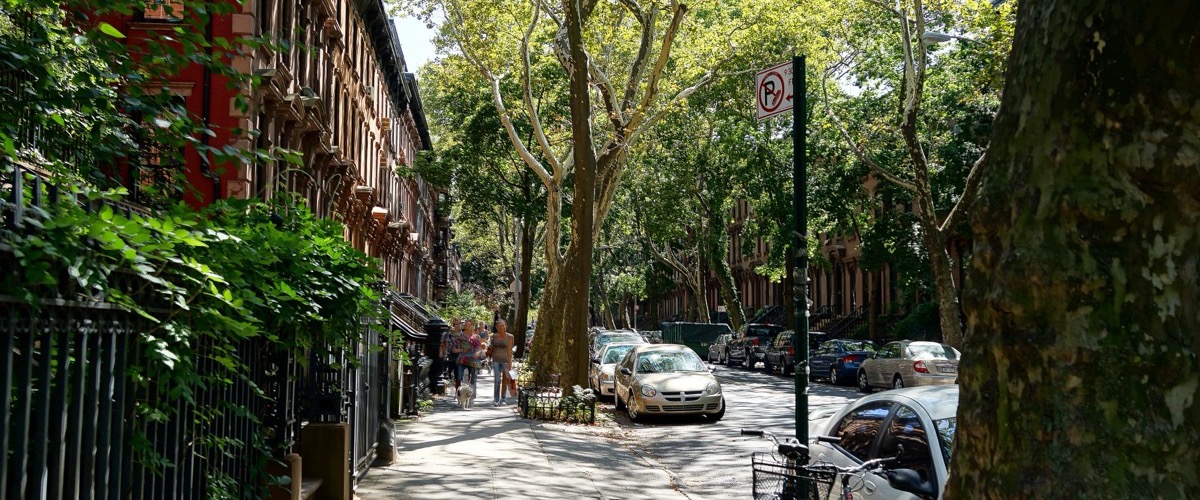
Fort Greene and Clinton Hill are neighboring Brooklyn areas, each a landmarked historic district, built around row houses, a hilltop park and the former mansions of Clinton Avenue. The decision usually turns on stairs, the building type and the walk to a C or G station.
- Local government
- City of New York, Kings County
- Smaller-home types
- Row houses, apartment buildings, co-ops, condos
- Nearest hospital
- The Brooklyn Hospital Center
- Evacuation zone
- Check by address
Fort Greene and Clinton Hill at a glance
NYC Planning lists Fort Greene and Clinton Hill as separate neighborhood areas, both in Brooklyn Community District 2 with Downtown Brooklyn and DUMBO. This page treats them together because they share a boundary, a park and a stretch of subway.
NYC Parks says General Nathanael Greene supervised the construction of Fort Putnam on the site in 1776, and that the city designated it a public park in 1845. The LPC's 1978 report describes a middle-class residential district built up mostly between about 1850 and 1880. Clinton Hill's 1981 report says it began as a suburban retreat, became a middle-class neighborhood and by the turn of the century was partly transformed into an area of great wealth; it calls Clinton Avenue, from Myrtle to Atlantic, one of America's great residential boulevards and the area Brooklyn's "Gold Coast".
Sources: NYC Parks, Fort Greene Park history; LPC, Fort Greene Historic District report (1978); LPC, Clinton Hill Historic District report (1981).
Homes for downsizers in Fort Greene and Clinton Hill
The LPC says Fort Greene's houses are primarily three and four-story rowhouses, most of brownstone or brick, and that some mansions were later replaced by apartment houses. For Clinton Hill it lists unified blockfronts of brownstone and brick rowhouses, apartment buildings, tenements, carriage houses and institutional buildings, and says several of the finest residences passed to Pratt Institute and St. Joseph's College.
- Row houses. Expect stoops and several floors. In a historic district, owners are obliged to obtain a permit from the LPC for work it regulates. Ask about the roof, the boiler and the legal status of any rental unit, and see our older home guide if you are selling one.
- Apartment buildings. A co-op is shares plus a proprietary lease and board approval; a condo is a deeded unit. Do not assume which from the look of a building.
- Elevator or walk-up. Ask about the steps from the street to the door and to the laundry.
Confirm any building's ownership type in the offering plan or through the seller's attorney. The co-op and condo guide covers what to request, and the comparison of home types helps weigh a row house against an apartment.
Sources: LPC reports for Fort Greene and Clinton Hill; LPC permit guide.
Getting around Fort Greene and Clinton Hill
The MTA's line maps show these stations.
- C. Lafayette Av and Clinton-Washington Avs. Neither is marked accessible. The C also stops at Hoyt-Schermerhorn, which is not marked accessible, and at Jay St-MetroTech, which is.
- G. Fulton St, Clinton-Washington Avs and Classon Av are all local stops and none is marked accessible.
- Atlantic Av-Barclays Ctr. Marked accessible, with many subway lines, and the Long Island Rail Road has trains that begin or end at Atlantic Terminal.
For buses and a door-to-door trip, use the MTA trip planner, and see the MTA's accessibility information. Riders 65 and older can use reduced fare; our guide to getting around after 65 explains it.
Sources: MTA line maps for the C, G and A; MTA, Long Island Rail Road.
Health care near Fort Greene and Clinton Hill
The Brooklyn Hospital Center is at 121 DeKalb Avenue in Fort Greene. NYU Langone runs a 24-hour off-campus emergency department at 70 Atlantic Avenue in Cobble Hill, and NewYork-Presbyterian Brooklyn Methodist Hospital is at 506 6th Street in Park Slope. Ask your doctors which hospital they use and check your plan.
Sources: The Brooklyn Hospital Center; NYU Langone, Cobble Hill; NewYork-Presbyterian in Brooklyn.
Parks, libraries and everyday life
- Fort Greene Park. Between Myrtle and DeKalb Avenues, with basketball and tennis courts, playgrounds and public restrooms. Olmsted and Vaux prepared its design in 1867, and the Prison Ship Martyrs Monument, by McKim, Mead and White, was dedicated in 1908.
- BAM. The Brooklyn Academy of Music presents film, music, theater and dance. The LPC has designated a BAM Historic District.
- Pratt Institute. The LPC's Clinton Hill report says Pratt and St. Joseph's College acquired and maintained some of the area's finest residences.
- Libraries. Use the Brooklyn Public Library location finder for the nearest branch.
- Older adult centers. Call NYC Aging's Aging Connect at 212-244-6469 or use its services finder.
Sources: NYC Parks, Fort Greene Park; BAM; NYC Aging.
Storms, flooding and insurance here
Kings County was among the counties in the federal declaration for Hurricane Sandy in October 2012. Flood exposure is an address-level question.
- Look up the address in the Hurricane Evacuation Zone Finder; the city explains its six zones on its evacuation page.
- Check the FEMA Flood Map Service Center, a different map.
- Standard homeowners policies typically exclude flood; ask about a separate policy and see FloodHelpNY.
- For a garden-level or basement space, ask whether it has taken on water.
See the flood and storm insurance guide.
Sources: NYS DHSES, FEMA-4085-DR-NY; FEMA, flood insurance.
Property taxes and local government here
The city bills property tax in Kings County. The Senior Citizen Homeowners' Exemption covers one to three family homes, condos and co-ops (co-ops apply separately) for owners 65 or older with combined income of $58,399 or less; the deadline is March 15, or March 16 in 2026. Enhanced STAR lowers school taxes for owners 65 and older within its income limit, and a buyer registers with the state. A co-op or condo board applies for the city's abatement for the whole building. On a sale, state and city transfer taxes apply; the net proceeds calculator estimates them. See costs and money and the senior exemptions guide, and ask a New York lawyer or CPA to confirm your own case.
Sources: NYC 311, SCHE; NY Tax Department, STAR; NYC Finance, RPTT.
Questions to ask before you buy here
- Is this a row house, a co-op or a condo, and what documents prove it?
- Is it inside a historic district, and what exterior work would need an LPC permit?
- How many steps lead to the door, the laundry and storage?
- Which C or G station would I use, and is it marked accessible?
- If there is a rental unit, is it legal? How would I live with it or without it?
- What does the address show on the evacuation zone finder and FEMA's map?
- For a co-op, what is the flip tax and what does maintenance cover?
The downsizing plan covers the steps, and the Brooklyn guide compares other areas. Park Slope sits close by. To be introduced to an agent, get matched with one on the operating team at eXp Realty; introductions go only to agents on that team, so this is not a search of the whole market.
Questions people ask
Are Fort Greene and Clinton Hill historic districts?
Yes. The Landmarks Preservation Commission designated the Fort Greene Historic District in 1978 and the Clinton Hill Historic District in 1981. In a historic district, exterior work generally needs a permit from the Commission, so ask the seller what has been done and what you might want to do.
What kinds of homes are in Fort Greene and Clinton Hill?
The LPC describes Fort Greene as primarily three and four-story row houses of brownstone or brick. For Clinton Hill it describes rowhouses, late 19th-century homes, apartment buildings, tenements, carriage houses and former mansions. Co-op, condo or rental status has to be checked building by building.
Which subway lines serve the area?
The MTA's line maps show the C at Lafayette Av and Clinton-Washington Avs, and the G at Fulton St, Clinton-Washington Avs and Classon Av. None of those stops is marked accessible. Jay St-MetroTech and Atlantic Av-Barclays Ctr, a short trip away, are marked accessible. Use the MTA trip planner for your own address.
Which county and government serve this area?
Fort Greene and Clinton Hill are in Kings County and the City of New York, in Brooklyn Community District 2. The city's Department of Finance bills property tax and handles the senior homeowner exemption.
More neighborhoods to compare
- Brooklyn HeightsA landmarked Brooklyn district of row houses and apartment buildings beside the Promenade.
- Bay RidgeSouthwest Brooklyn, with brick two-family homes, apartment buildings and the Shore Road waterfront.
- Park SlopeRow houses and apartment buildings on the slope west of Prospect Park.
- Sheepshead Bay and Manhattan BeachA bayfront part of south Brooklyn where a flood check comes before the floor plan.
- Carroll Gardens and Cobble HillLandmarked brownstone blocks between Atlantic Avenue and the Gowanus Canal.
- Downtown Brooklyn and DUMBOBorough Hall, DUMBO and Boerum Hill, near many subway lines.
Plan your move
We can introduce you to a licensed New York area agent with eXp Realty who works with homeowners moving to less house. New York Downsizing is operated by licensed agents affiliated with eXp Realty and is not a New York brokerage.